
Records Retention Schedule
A Records Retention Schedule is a policy document used by employees to determine how long to keep Official records and contains categories of records called Record Classes with retention period requirements.
The Records Retention Schedule is media neutral – meaning that it includes requirements for both physical and electronic records.
The content of the record, not its format, determines how the record is classified on the Retention Schedule - dictates the appropriate Record Class and retention.
Multiple departments may use the same record class. The Retention Schedule indicates how long the records must be retained, but does not indicate the departmental owners.
The Records Retention Schedule provides:
- a consistent way to apply retention
- a consistent way to manage records
Record Classes
Each record class is made up of the following parts:
- Code: Unique alpha-numeric code assigned to the record class.
- Parent: Name of the overall business function that the record class is a part of.
- Name: Descriptive title of the record class.
- Description: Narrative description of the category or group of records that support the same business process and that have similar retention requirements.
- Jurisdiction: Notations if the record class pertains to specific jurisdictions only.
- Record Examples: Representative examples of the kinds of documents, files, reports, forms, and data that are classified in each record class. Please note this list is not intended to be exhaustive and is meant to cite common examples only. Many of the examples listed will be unique records that are typically associated with the record class; in some cases, commonly used standard names are also provided.
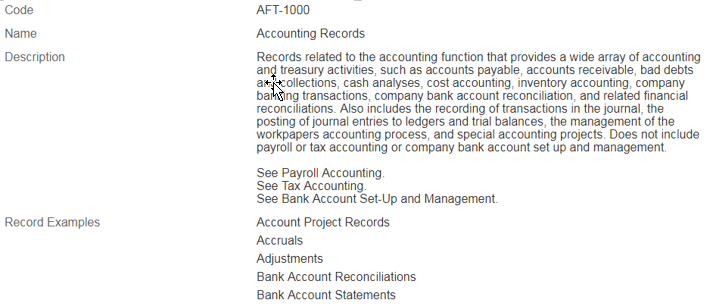
- The Records Retention Schedule can seem overwhelming. However, it is important to realize that you will only have to become familiar with the Record Classes that apply to your job. This will likely be a small number of classes that you will use on a regular basis.
- The Records Retention Schedule is organized by business function rather than by department. This means that multiple departments can share a record class if they are responsible for maintaining any of the records in that class.
Time Based Retention
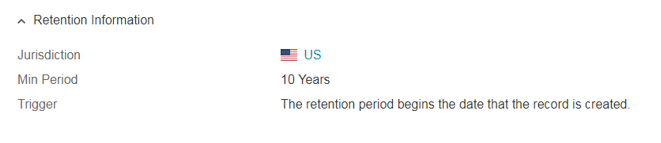
There are two types of retention calculation: time-based and event-based.
Time-based retention starts when the record is created. In this example, Accounting Records are retained for 7 years after they are created.
Event Based Retention
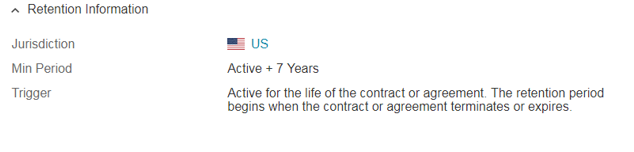
Event based retention periods starts after the conclusion of an event, also known as a “trigger”.
In the example, contracts and agreements are retained for 7 years after the contract or agreement terminates or expires.
The trigger defines when retention begins to calculate.
Comments
0 comments
Article is closed for comments.